
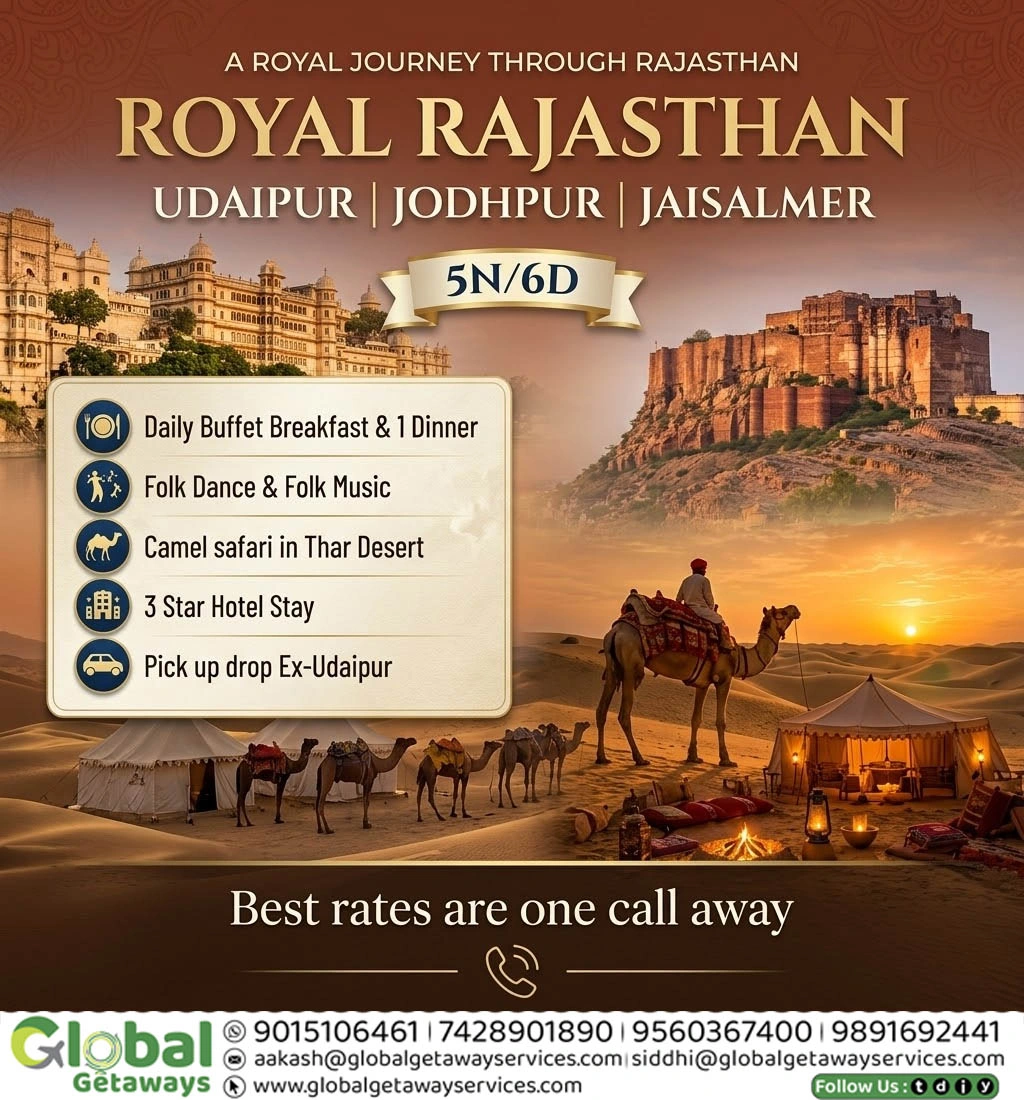
Royal Rajasthan Tour Package: Udaipur, Jodhpur & Jaisalmer (5N/6D)
A Royal Journey Through Lakes, Palaces & Golden Thar Sand Dunes | Ex-Udaipur

⚡ Quick Tour Snapshot: 5N/6D Royal Rajasthan Circuit at a Glance
Circuit Route: Udaipur (2 Nights) ➔ Jodhpur (1 Night) ➔ Jaisalmer Desert Camp & City (2 Nights) ➔ Departure Ex-Udaipur.
Duration: 5 Nights / 6 Days (Ideal for Families, Couples, Senior Citizens & Group Tours).
Key Inclusions: 3-Star Hotel & Luxury Desert Camp Stays, Daily Buffet Breakfast & 1 Gala Desert Camp Dinner, Authentic Rajasthani Folk Dance & Music Night, Sunset Camel Safari on Sam Sand Dunes, Dedicated Private AC Vehicle with Chauffeur for Pickup, Drop & Sightseeing (Ex-Udaipur).
Verified Operator: Book directly with Global Getaways Official Portal (Govt. of India NIDHI Reg. ID: EDL002580 | Incredible India Approved).
🏛️ Officially Recognized & Globally Verified Travel Enterprise
Your holiday investments, desert camp reservations, and payments are 100% verified, licensed, and protected by premier government authorities.
• Ministry of Tourism (NIDHI: EDL002580)
• Incredible India Registered Partner
• Delhi Tourism Approved Agency
• MSME / Udyam Certified Enterprise
• 100% GST Registered & Compliant
• Regulated Corporate Bank Accounts
• Google Business Profile Verified
• Apple Maps & Bing Places Approved
• TripAdvisor Associated & Rated Partner
Discover our complete collection of tailor-made domestic and international packages on the Global Getaways Home Page.
Step into the land of regal palaces, invincible fortresses, vibrant desert cultures, and timeless Rajput bravery! Global Getaways presents the definitive royal holiday: our hand-crafted 5 Nights & 6 Days Royal Rajasthan Package covering the romantic waters of Udaipur, the majestic blue citadel of Jodhpur, and the glowing golden dunes of Jaisalmer.
Planning a multi-city Rajasthan road trip requires trusted desert camp allotments, sanitized private vehicles, experienced local mountain/highway chauffeurs, and verified 3-star accommodations. Why risk your precious family holiday with unregulated online third parties? Operating directly from our neighborhood desk at Paradise Shopping Plaza, Madhu Vihar (East Delhi), we provide complete transparency. Families, couples, honeymooners, and corporate groups living across Madhu Vihar, I.P. Extension societies, Patparganj, Preet Vihar, Karkardooma, Nirman Vihar, Vaishali, and Noida can walk straight into our office for face-to-face consultation, customized inclusions, and guaranteed booking confirmations!
What is the Day-Wise Itinerary for the 5 Nights / 6 Days Royal Rajasthan Tour?
This royal circuit is thoughtfully planned with relaxed transit times and immersive cultural sightseeing:
- Day 1: Arrival in Udaipur & Evening Lake Pichola: Arrive at Udaipur Airport or Railway Station. Meet our private chauffeur and transfer to your 3-star hotel. After check-in and relaxation, head out for a peaceful evening boat ride on Lake Pichola, admiring the sunset views of Jag Mandir and the illuminated City Palace. Overnight stay in Udaipur.
- Day 2: Full-Day Udaipur City of Lakes Exploration: After a delicious buffet breakfast, explore the sprawling City Palace Complex (the largest palace complex in Rajasthan). Visit the historic Jagdish Temple, stroll through the royal courtyard fountains of Saheliyon ki Bari, and drive along the scenic banks of Fateh Sagar Lake. Evening free for traditional Rajasthani handicraft shopping at Hathi Pol Bazaar. Overnight stay in Udaipur.
- Day 3: Udaipur to Jodhpur (The Blue City) via Ranakpur: After breakfast, embark on a scenic drive to Jodhpur. En route, visit the world-famous 15th-century Ranakpur Jain Temples, acclaimed for their 1,444 intricately carved marble pillars. Arrive in Jodhpur, check in to your hotel, and visit the colossal Mehrangarh Fort towering over the blue city, followed by the serene white marble cenotaph of Jaswant Thada. Overnight stay in Jodhpur.
- Day 4: Jodhpur to Jaisalmer (Thar Desert Camp Experience): Post breakfast, drive towards the Golden City of Jaisalmer. Head straight to the luxury Swiss tents at Sam Sand Dunes. Check in with a traditional Rajasthani welcome. Enjoy a thrilling Sunset Camel Safari across the rolling sand dunes. In the evening, immerse yourself in a vibrant Rajasthani Folk Dance & Music Show (Kalbeliya & Langa performers) around a crackling bonfire, followed by an authentic Rajasthani Buffet Dinner. Overnight stay in desert camp.
- Day 5: Jaisalmer Golden Fort & Heritage Havelis: Savor breakfast amidst the desert sands and transfer to Jaisalmer city. Explore the living Jaisalmer Fort (Sonar Qila), the exquisitely carved Patwon ki Haveli, Nathmal ki Haveli, and the picturesque Gadisar Lake surrounded by historic chhatris. Overnight stay at a 3-star hotel in Jaisalmer.
- Day 6: Jaisalmer to Udaipur Drop (Tour Concludes): Enjoy your morning buffet breakfast. Board your comfortable private AC vehicle for your return transfer to Udaipur Airport / Railway Station for your journey home with unforgettable royal memories!
Which Destinations and Royal Attractions Are Covered in This Package?
| City Hub | Major Monuments & Sightseeing | Signature Experience |
|---|---|---|
| Udaipur (2 Nights) | City Palace, Lake Pichola, Saheliyon ki Bari, Jagdish Temple, Fateh Sagar Lake. | Romantic royal architecture & picturesque lake sunsets. |
| Jodhpur (1 Night) | Mehrangarh Fort, Jaswant Thada, Clock Tower Market, Umaid Bhawan Palace view. | Panoramic blue city views & rich Marwar heritage. |
| Jaisalmer (2 Nights) | Sam Sand Dunes, Jaisalmer Golden Fort, Patwon ki Haveli, Gadisar Lake. | Thar Desert Camel Safari, Folk Dance & starlit camp night. |
What is Included in Global Getaways’ 5N/6D Royal Rajasthan Tour Package?
✅ Package Inclusions
- 🏨 5 Nights Accommodations: 4 Nights in verified 3-star hotels (Udaipur & Jaisalmer) + 1 Night in a luxury desert camp at Sam Sand Dunes.
- 🍽️ Meal Plan: Daily wholesome Buffet Breakfasts at all hotels + 1 Traditional Gala Dinner at the Thar Desert Camp.
- 🐪 Desert Adventure: Guided Sunset Camel Safari across the golden Sam Sand Dunes.
- 🎭 Cultural Entertainment: Evening Rajasthani Folk Dance, Kalbeliya performance, live music & campfire.
- 🚗 Dedicated Private AC Vehicle: Complete intercity travel, sightseeing tours, and airport/station pick-up and drop (Ex-Udaipur) with no sharing.
- 🛣️ All Taxes Covered: State taxes, toll charges, parking fees, and driver allowances fully included.
❌ Package Exclusions
- ✈️ Airfare or train tickets to and from Udaipur (Can be arranged by our flight desk).
- 🎟️ Monument entry fees, camera charges, and guide fees at forts/palaces.
- 🚙 Optional Thar Desert 4×4 Jeep Dune Bashing or Quad Biking.
- 🧾 Personal expenses, laundry, tips, and room service.
- 🏛️ Government GST, if applicable.
Why Book Your Rajasthan Holiday with Global Getaways in East Delhi?
- 🏢 Walk-in Consultation: Visit our local office at Paradise Shopping Plaza, Madhu Vihar (near I.P. Extension) to review real hotel photographs, vehicle numbers, and desert camp amenities face-to-face.
- 🚗 100% Private Chauffeur Fleet: Polite, highly experienced drivers who understand scenic rest stops, hygiene, and safe highway driving.
- 📜 100% Financial Safety: Licensed and registered by the Ministry of Tourism (NIDHI EDL002580), Incredible India, Delhi Tourism, MSME, and GST compliant.
- 📞 24/7 Dedicated Ground Support: Instant concierge coordination for smooth check-ins, early breakfast arrangements, and customized timings.
🌟 Connect With Global Getaways Across Platforms!
Follow us for daily travel inspiration, royal Rajasthan videos, client reviews, and exclusive holiday deals across all our official channels:
📷 Instagram
▶️ YouTube
👍 Facebook
📍 Google Profile
🦉 TripAdvisor
𝕏 Twitter
💼 LinkedIn
📞 Justdial
Frequently Asked Questions (FAQs)
Q1: What are the primary cities covered in the 5 Nights / 6 Days Royal Rajasthan package?
This royal circuit covers Udaipur (2 Nights), Jodhpur (1 Night), and Jaisalmer (2 Nights, including Sam Sand Dunes Desert Camp), with pick-up and drop transfers ex-Udaipur via dedicated private AC vehicle.
Q2: What is included in the Jaisalmer Thar Desert experience?
The Jaisalmer desert experience includes 1 night in luxury Swiss tents at Sam Sand Dunes, a sunset camel safari, traditional welcome, Rajasthani folk dance and music performance, and a gala buffet dinner around a bonfire.
Q3: Where can I book verified Rajasthan holiday packages in East Delhi?
You can visit Global Getaways at Paradise Shopping Plaza, Madhu Vihar, East Delhi 110092 (Ministry of Tourism Reg ID: EDL002580). We provide face-to-face consultation, private vehicles, verified desert camps, and customized itineraries for clients across I.P. Extension, Patparganj, Preet Vihar, and Noida.
Book Your Royal Rajasthan Journey Today!
Verified 3-Star Hotels & Luxury Desert Camps Are Just One Call Away!
📞 Call / WhatsApp: +91 90151 06461 | +91 74289 01890 | +91 95603 67400 | +91 98916 92441
✉️ Email: aakash@globalgetawayservices.com | siddhi@globalgetawayservices.com
🌐 Website: www.globalgetawayservices.com
🏢 Office Address: Paradise Shopping Plaza, A-35/32 Street No-2, Madhu Vihar, East Delhi 110092 (Near Patparganj, I.P. Extension, Preet Vihar & Karkardooma)